

_edited.png)
Show me the dust on your shoes
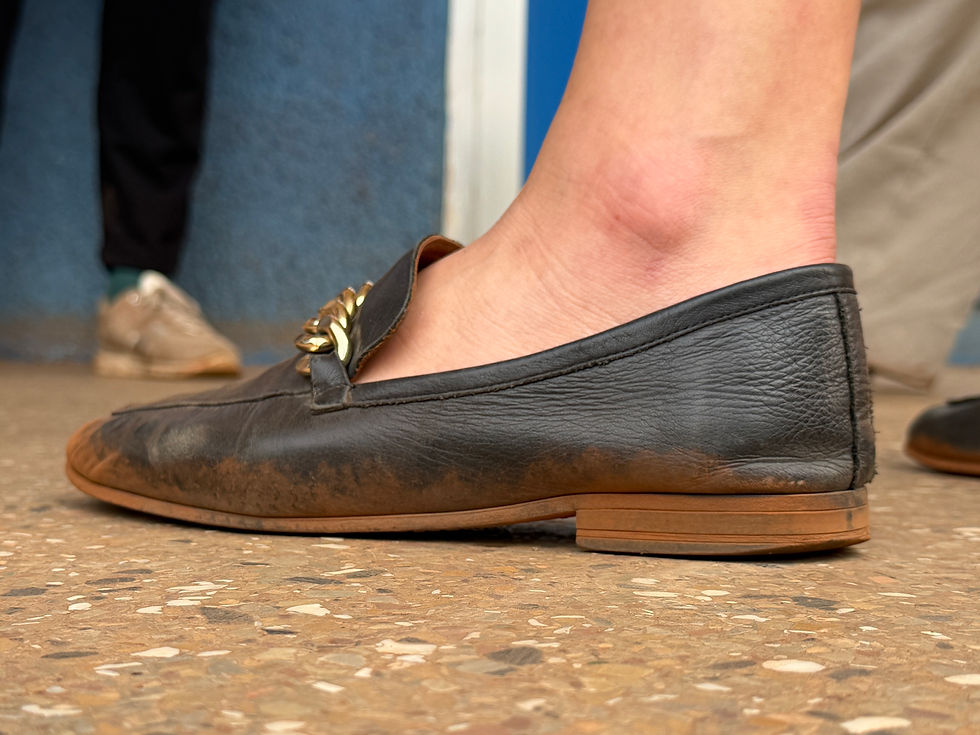
I say this more and more these days, sitting in air‑conditioned boardrooms while the language of development soars higher and higher above the ground it claims to serve.
It is not a romantic appeal to some lost golden age of activism. It is a simple test of honesty: when last did the soles of your shoes carry the dust of the places you speak for?
Because many of the loudest voices in our sector seem to have graduated from the grassroots as if it were high school – a phase to be completed, remembered fondly, and then left behind. Their natural habitat now is glass and steel: conference centres, corporate HQs, shimmering offices where strategy is preached like a gospel.
We used to design programmes with our hands in the soil.
Budgets were cramped, timelines unrealistic, politics messy – but at least one assumption held in the rooms where programmes were born: something real needed to move in the world. Classrooms had to be built, young people had to find work, clinics had to function after the ribbon‑cutting. We could argue about the best route there, but we were arguing about mechanisms – the actual gears and pulleys of change.
Somewhere along the way, those gears were replaced by mirrors.
Today, design conversations often orbit a gentler, mistier vocabulary of “ecosystems”, “pathways”, “capacities”, and “journeys”.
We speak of youth “navigating pathways to dignified livelihoods” instead of asking which training providers will still be solvent when the grant ends. We celebrate “strengthened community resilience” without specifying whether that means a savings group that still meets, a clinic that still opens, or a municipal official who now answers their phone.
Metaphors are not the enemy.
They are how we first see a pattern clearly enough to act. The trouble begins when the metaphor replaces the mechanism – when the elegant abstraction arrives early, and the awkward details never catch up. It is in that gap that impact quietly drains away.
Dustless shoes are very good at metaphors.
They know the latest phrases by heart: systems change, localisation, just transitions, catalytic capital. They can map actors on a wall with coloured sticky notes and explain the political economy of a township they have only ever visited with a security escort. They know how to hold the attention of a room.
But when you ask the questions the dust demands – Who will do this on Wednesday morning? With what budget line? Under which job description? After which training? Instead of what? – the room shifts in its seat. People glance at each other. Someone says, “That’s why we need a holistic approach,” and reaches for another metaphor.
“Show me the dust on your shoes” is about proportion.
If your work keeps you in glass buildings, so be it; strategy matters. But strategy that has not recently walked through a clinic corridor, or sat in a ward meeting, or listened to a youth worker at the end of their shift, tends to float. It becomes a language game, fluent and impressive, but basically weightless.
This is how we went from mechanisms to metaphors.
Sustainability used to mean: will this thing still exist when the donor leaves?
Brick and mortar, staffing levels, revenue lines, and policy commitments sat at the centre of the question. It was prosaic and unsentimental: who will pay salaries, who will maintain the roof, who will keep the youth centre open?
Now, “sustainability” often arrives in documents like a spell. We place it near other powerful words – ownership, partnership, systems, resilience – and trust that their proximity will conjure permanence.
We promise “sustainable, scalable impact” in contexts where we cannot yet guarantee next year’s rent. We reassure ourselves that if enough stakeholders “buy in” at a workshop, longevity will follow.
A more honest use of the word feels different on the tongue:
After the grant, the cost of this programme is X per beneficiary, and here are the Y credible payers who might cover it.
We are not yet sustainable; here is the gap; here is our plan; here are the risks.
The community owns this in spirit; the municipality owns it on paper; no one yet owns it in their budget.
There is no poetry there. There is, however, the beginning of truth – and truth, in this work, usually has dust on its shoes.
The people who rise quickest in our ecosystem today are not necessarily those with the dustiest soles; they are those with the smoothest sentences.
They have learned to be diplomats.
When governments, corporates, multilaterals, NGOs, and communities all stand around the same table, the person who can keep everyone seated is celebrated. Sharp edges are sanded down. Trade‑offs are translated into “win‑wins”. Tension is alchemised into “dialogue”.
There is real skill in this, and in fragile contexts it can be lifesaving. The problem is not that we have diplomats; it is that we increasingly behave as if diplomacy were the work.
Programme designers become negotiators of expectations rather than architects of interventions. Resource mobilisers become storytellers who must hurt no one and satisfy everyone. Monitoring and evaluation becomes a language for reassurance rather than a discipline for learning.
In that world, the practitioner – the one who keeps asking “But who will do this? With what? When the project closes?” – starts to feel out of place. Their questions sound impolite in rooms dedicated to harmony. They bend conversations back down from the clouds.
So, they learn to speak the new tongue. Or they leave.
There is a deeper psychology beneath this drift.
Concrete mechanisms can fail. A costed plan can be naive. A revenue projection can collapse. A staffing model can prove impossible. When you bind yourself to specifics, you bind your reputation to a future that may judge you harshly. In precarious institutions, in fragile economies, that vulnerability is expensive.
Abstraction is safer. You are unlikely to be fired for your stance on “transformative systems change”; you might be sidelined if your jobs target is missed. You are unlikely to lose a grant because your theory of change diagram was too ambitious; you might, if your line‑item budget exposes just how thin the whole proposition really is.
So we move upwards.
We interrogate power, deconstruct narratives, run reflection circles, draft principles. These things matter. But done without dust, they become another layer of insulation between our words and the worlds they describe.
We did not start here. We arrived here one meeting at a time, choosing safety over exposure.
“Show me the dust on your shoes” is not an accusation. It is an invitation.
It invites the strategist in the glass tower back to the clinic, the school, the farm, the taxi rank. It invites the grant writer back to the youth centre at 5 p.m. on a Friday, when the programme is over but the lives it touched are still unfolding. It invites the corporate CSI lead to sit through a municipal budget hearing, to feel the cold reality behind the word “handover”.
It also invites those of us who still live close to the ground not to retreat into cynicism.
It is tempting, when you have dust on your shoes, to sit at the back of the workshop and roll your eyes at the metaphors on the screen. To mutter about “these people who’ve never run a project” and quietly withdraw. But cynicism is just another glass wall; it keeps you safe from disappointment but far from influence.
What we need is not purists or diplomats, but a reunion.
A reunion between strategy and street, between the glass building and the gravel road. A practice where those who live in boardrooms are required – not invited, required – to acquire fresh dust regularly. And where those with dust on their shoes are given microphones and pens, not only attendance registers and reporting templates.
The sector will not change overnight. The incentives that reward polished abstraction and punish grounded specificity are real. Donors still like clean diagrams. Corporates still like neat stories. Institutions still fear failure.
But in the rooms we hold, in the documents we draft, in the questions we keep asking, we can tip the balance back – even slightly – toward reality.
Keep your metaphors, but marry them to mechanisms.
Speak of sustainability, but refuse to use the word as a spell.
Use diplomacy, but never forget that the only credibility that really matters, in the end, is the kind that leaves dust on your shoes.


32 WIN nhìn qua thì đỡ “mê cung” hơn mấy trang mình từng bấm thử trước đây. Mình vào kiểu tiện tay thôi, tưởng lại phải đoán xem thông tin nằm đâu, ai ngờ lướt một vòng là thấy bố cục chia khối khá ngay ngắn, đọc tới đâu hiểu tới đó nên không cần căng não; mấy chỗ hiển thị dữ liệu họ để dạng bảng theo cột nên liếc nhanh là nắm được ý chính, đỡ cảnh kéo qua kéo lại như đang đọc bảng tính lỗi. Menu cũng đặt dễ thấy nên chuyển qua lại giữa các mục khá lẹ, cảm giác như đang đi siêu thị có biển chỉ dẫn, không phải vừa đi vừa tự…
https://rr88m1.com/ ờ thì mình cũng chỉ tiện tay bấm vào xem thử thôi, dạo này nhiều trang nhìn giống nhau nên mình không kỳ vọng gì; lướt qua vài phút thấy giao diện khá thân thiện, chữ nghĩa và khối nội dung đặt gọn gàng nên mắt đỡ mệt, chuyển giữa các mục cũng ổn, bấm qua lại không thấy đứng hay quay vòng quá lâu; mình để ý họ có để hẳn phần thông tin nguồn gốc/pháp lý công khai ngay trên web nên ai muốn kiểm tra sơ thì khỏi phải mò, kiểu trình bày thẳng và dễ tìm; mình không đào sâu mấy phần game hay khuyến mãi, chủ yếu xem cảm giác dùng có “mượt” không…
Trước giờ mình cũng chỉ xem cầu kèo cho biết, coi như tham khảo chứ không đặt nặng chuyện đúng sai. Có thời gian mình còn thử ghi chép mấy dàn số thấy hay về, rồi đem so lại xem có lặp theo kiểu gì không, nhưng theo càng lâu càng thấy mình dễ bị cuốn theo cảm xúc. Hôm nào trúng thì hăng quá tay, còn bữa trượt thì lại muốn gỡ cho bằng được, thành ra tự làm mình căng thẳng. Sau này mình đọc thêm vài bài kiểu soi cầu xsmb pro để hiểu cách người ta suy luận, thấy hữu ích ở chỗ nhắc mình giữ kỷ luật và biết dừng đúng lúc, coi như giải…